TL;DR: 48 hours, a small team, and a mandate to decide rather than explore. In 2025, ADEO gathered a small team of designers for two days of hackdays on the future of tools for in-store staff. I contributed as the AI UX representative, tasked with exploring how artificial intelligence could genuinely enrich the experience. We designed a unified, modular, scalable vision, conceived as a single intelligent access point for daily store operations. This work set off a deeper shift: moving from a set of isolated tools to a platform of experiences.
Context
In-store staff today operate within a rich but deeply fragmented ecosystem. Every task (checking information, verifying a situation, acting on a product, managing an operation) requires juggling between several tools built at different times, with distinct logics and no consistency between their interfaces. For staff, this means:
- constant back-and-forth,
- high mental load,
- priorities that are hard to perceive,
- long navigation paths,
- little connection between pieces of information.
In this context, ADEO organized two days of "hackdays" to imagine what the future of the in-store experience could look like. I was invited to join this small team, with a specific role: carry the AI lens to give a clear direction to future use cases, beyond the reflex of "just build a chatbot."
Understanding the fragmentation
Before imagining a solution, we analyzed the real tasks: what staff actually do, in what order, with what degree of urgency, which tools they need to open, and where the journey breaks down. We found that the current ecosystem runs on a "tool-first" logic, which forces the user to know where to go before they can act. This structure imposes a heavy cognitive load: the burden of navigation falls entirely on the human. The opportunity was clear: imagine a single, coherent, fluid access point, capable of orchestrating actions rather than scattering them.
My contribution
I worked on rebuilding the store experience into a more legible, systemic form: which tasks are cross-cutting, which data needs to converge, what should be immediately visible, and what should adapt to each staff member's context. The goal: move from a set of independent tools to an orchestrated experience, capable of supporting staff from diagnosis to action, without interruption.
Imagining a smart, contextual search
One of the major pain points identified was the need to "know where to go" within a fragmented ecosystem. To address this structural friction, I led the design of a unified search, conceived as a universal access point to all information and tasks. Inspired by the principles of Sentient Design, this search acts as an intelligent presence rather than a mere feature:
- it adapts to the role,
- it accounts for the time of day,
- it interprets the intent behind the query,
- it smooths access to action rather than to navigation.
It turns the ecosystem into a natural journey, where staff no longer need to know the technical structure to reach what they need.
Sentient Design: AI and the Next Chapter of UX
Josh Clark, Big Medium — bigmedium.com/speaking/sentient-design-josh-clark-talk.html
Positioning AI as an experience framework, not a chatbot
In a two-day format, the natural pull is to prototype the most visible, easiest-to-pitch solution: a chatbot. It's the option that sells itself at the end of a hackday. I took the opposite approach: slow down on the real use cases before deciding, even if it meant proposing a direction that was less spectacular to present but more accurate. As the AI representative, I repositioned artificial intelligence appropriately. Rather than "conversationalizing everything," the idea was to build an AI that is discreet, integrated, and contextual — one that strengthens understanding of situations, surfaces priorities, and anticipates what could become a pain point. AI becomes a lever for orchestration: it clarifies what matters, simplifies decisions, and makes the experience more fluid, without taking control of the task itself. The goal wasn't to add more AI, but to make AI useful, centered on people.
An orchestrated vision that transforms the ecosystem
By the end of the two days, we proposed a vision capable of:
- unifying tasks,
- centralizing essential information,
- adapting the experience by role,
- surfacing priorities,
- simplifying access to action,
- and integrating AI as a natural amplifier, not a decorative layer.
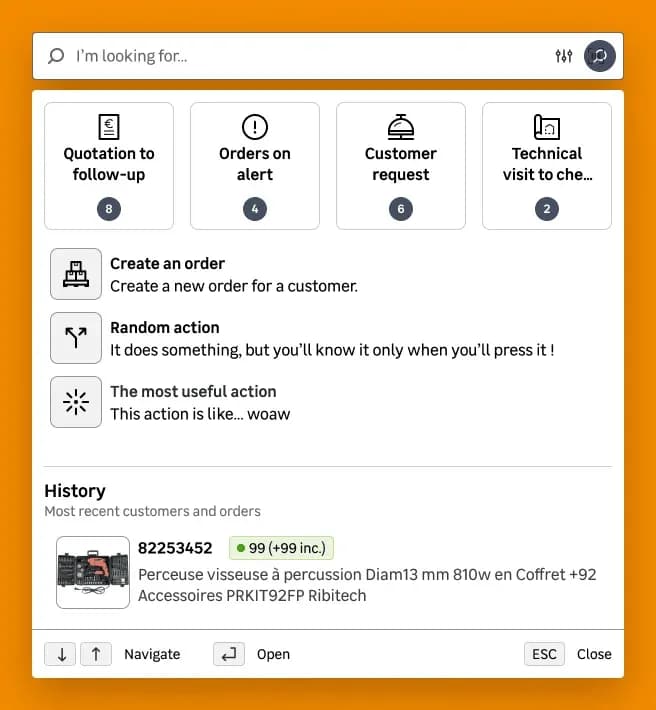
This vision introduces a paradigm shift: we're no longer designing products, but experiences — orchestrated, contextualized modules that share a common language and work together. It sets off a deeper shift within the ADEO ecosystem: moving from a "tool" logic to an experience-first logic, more coherent, more legible, and better suited to staff's real-world tasks.
My role, summarized
- UX Designer selected for these strategic hackdays,
- AI lens representative within the team,
- designer of the smart, contextual search,
- cross-functional experience architect,
- facilitator between designers, business, product, and data,
- co-author of a vision laying the groundwork for a platform of experiences.